


RJG1500 / RJG2200 / RJG2500 Steel Cage Roller Welding Machine
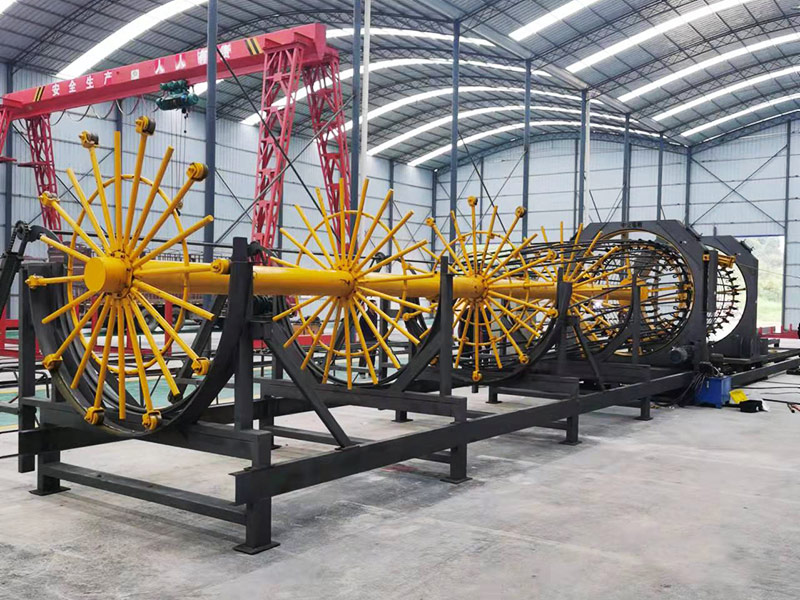
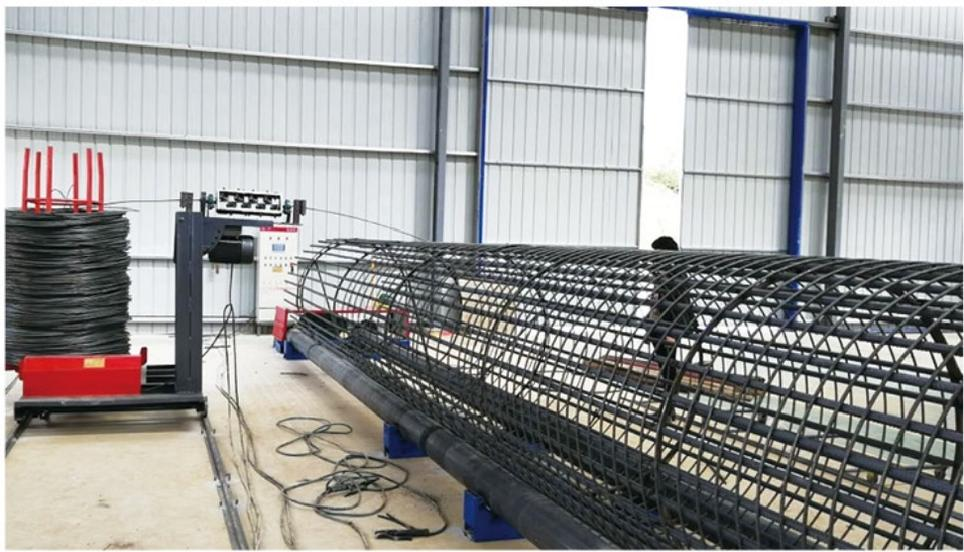
The RJG series is an intelligent rebar cage rolling welder for bored piles. It feeds main bars and winding wire automatically and welds them into a finished steel cage — round, straight and evenly spaced — while a crew of 3–6 workers loads bars and unloads finished cages. A shift produces 8–15 cage sections.
Three models cover the full pile range. The RJG1500 handles pile diameters from Ø600 to Ø1500 mm, the RJG2200 from Ø800 to Ø2200 mm and the RJG2500 from Ø1000 to Ø2500 mm. All three make cages 12 m long as standard, customisable to 15, 18, 21 or 25 m. Main bars run Φ12–32 mm and winding bars Φ6–16 mm, with stirrup spacing adjustable from 50 to 500 mm. Total power is 15–25 kW and the footprint is 30 × 6 × 2 m.
These machines suit bridge foundations, metro stations, high-rise pile foundations and precast pile plants — anywhere bored piles are made in volume. Compared with manual cage tying, a rolling welder keeps the cage round, the spacing even and the output steady across a whole shift, and it cuts the labour on each cage to a small crew. Send your pile diameter and cage drawing and we will reply with the right model and a quotation within 24 hours. WhatsApp: +86 13465772392.
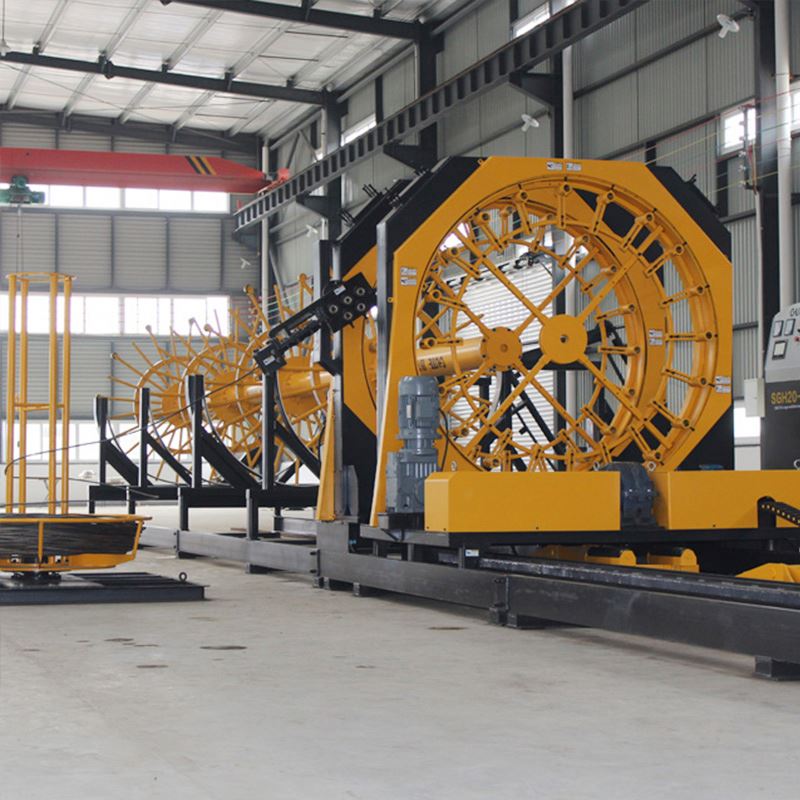
Intelligent rebar cage welding machines are core equipment in infrastructure projects such as bridges, high-speed railways, and building construction, emphasizing automation and precision processing. The equipment integrates an intelligent control system, automatically completing processes such as rebar feeding, winding, welding, and cutting, requiring minimal manual intervention.
Driven by a servo motor, parameters such as rebar cage diameter, length, and stirrup spacing are digitally adjustable, with errors controlled to the millimeter level, ensuring component consistency. Compared to traditional manual tying, efficiency is increased by 3-5 times, while also reducing rebar waste and labor intensity.
The equipment is easy to operate, equipped with a visual interface, allowing even beginners to quickly learn how to use it. Adaptable to processing different specifications of rebar cages, it is a key piece of equipment for improving the quality and efficiency of modern infrastructure projects.
Feature
1. Employs imported bearings, precision rack and pinion transmission, Guomao reducers, and Shanfang electric motors.
2. Utilizes Siemens programmable logic controllers, domestic brand touchscreens, high-performance frequency converters, and imported sensors and electrical components.
3. Scientifically and rationally designed machinery facilitates customer use and maintenance, with quick and easy spare parts replacement.
4. Excellent machining ensures stable and reliable product quality and long component lifespan.
5. The frequency converter features stepless speed regulation, stable and reliable quality, energy saving and environmental protection, and convenient adjustment. It allows customers to adjust according to different product sizes.
6. The touchscreen uses domestic or international brand touchscreens, ensuring stable and reliable quality. The visual interface is optimized for actual production needs, facilitating customer operation and use. Workers can operate the machine after simple training.
7. Equipped with multiple feeding trays to prevent main reinforcement bars from becoming misaligned during production.
8. The spacing of the main reinforcement bars depends on the pre-arrangement of the reinforcement bars on the formwork, the spacing of the sleeves with the same number of main reinforcement bars, and the precise control of the formwork with the same diameter as the reinforcement cage. A project typically requires 2-7 types of formwork, making operation convenient and quick.
9. Equipped with multiple sets of hydraulic support devices to prevent the reinforcement cage from sagging due to its own weight. To reduce worker labor intensity and provide high work efficiency and improve product quality, a chain-type main reinforcement bar feeder and an automatic welding robot are available as options (not standard, to be purchased separately).
10. Safe and convenient transportation. The equipment adopts a modular design, consisting of three main parts: the feeding rack, the main unit, and the unloading mechanism. These parts can be quickly disassembled, and the equipment can be assembled and disassembled within one day.

- Steel Cage Roller Welding Machine
- CNC Steel Bar Shear Line
- CNC Rebar Bending Center
- Rebar Straightening And Cutting Machine
- Rebar Hoop Bender
- Steel Bar Arc Bending Machine
- Steel Rebar Bending Machine
- Rebar Cutting Machine
- Five Head Stirrup Bending Machine
- Band Saw Rebar Cutting Machines
- Rebar Threading Machine
- Rebar Upsetting Machine
- CNC Rebar Sawing Threading Grinding Line
- CNC Rebar Stirrup Bending Machine


 Facebook
 Instagram
 youtube
 Email